Wednesday, 16 May 2018


Both - Either - Neither


We use both, either and neither to refer to two people or things.

BOTH

Both = the two; that one AND the other one; this one AND that one
Both can be used as a pronoun to refer to two things that we have already mentioned.
  • A: Do you want the blue shirt or the red one?
    B: I’ll buy both (= the blue shirt AND the red shirt = both shirts)

Both X and Y

= not only X but also Y
Both + Adjective + and + Adjective
  • He’s both tall and handsome.
  • I’m both happy and confused at the same time!
  • I have had a long, hard day and I’m both tired and hungry.
Both + Noun + and + Noun
Both can be used with a singular noun + and + singular noun
  • She speaks both English and Arabic.
  • They have both a cat and a dog.
  • He is both an actor and a director.
We can also use Both + plural noun (see more below)
  • She speaks both languages.

Both or Both of?

Both or Both of can be used without a difference in meaning though Both of is more common in the United States.

Both (of) + determiner + plural noun

You can use Both or Both of before a determiner (my, his, these, the etc.) and a plural noun.
  • Both (of) my friends arrived late to class.
  • Both of the wheels wobble too much.
  • A prize was given to both of the players.
When we use Both (without of), we drop the article the.
  • Both of the parents were nervous.
  • Both parents were nervous.

Both of + Object Pronoun

When using Both with an object pronoun (me, you, him, her, it, us them), we need the preposition OF before that pronoun.
  • He has invited both us. (incorrect)
  • He has invited both of us. (correct)
  • I’ll take both of them. (correct)
  • I need to speak to both of you. (correct)

Verb + Object pronoun + both

We can use both after an object pronoun
  • I hope they invite us both (= I hope they invite both of us)
  • Do you need them both? (= Do you need both of them)
  • The teacher sent them both to the principal’s office.

To be + both

Both comes after To Be (or an auxiliary such as have or modal verbs).
  • He is both intelligent and agile.
  • My sister and I are both ready for the trip.
  • We were both happy with our exam results.

Modal verb + both + verb

  • My parents can both speak French.
  • They should both try harder.
  • My brothers would both be shocked if they knew the truth.

Both + other verbs

Both goes before the other verbs. If there is an accompanying auxiliary verb, then it goes in the middle of the two verbs (i.e. auxiliary + both + verb)
  • We both wanted to stay in bed and not go to work.
  • They both liked the surprise.
  • My parents both work in the same building.
  • They have both studied a lot.

Both - Negative

We don’t use both in negative structures. Instead, we normally use Neither.
  • We don’t say: Both of them are not ready (incorrect)
  • We say: Neither of them are ready (correct)
See more about Neither below:


NEITHER

Neither = not one and not the other
Neither is a negative word and is accompanied by an affirmative singular verb.

Neither X nor Y

Neither … nor … is used as a conjunction. It is the opposite of “Both … and …” If a verb comes after this phrase, that verb is in the singular form (Sometimes you will hear it used in the plural form though it is not grammatically correct)
  • Neither John nor Fred likes doing the dishes. (= “Both John and Fred don’t like doing the dishes”)
  • I want neither the red shirt nor the blue shirt.
  • I neither smoke nor drink.

Neither + singular noun

Neither is used as a determiner before a single noun.
  • Neither team wanted to lose.
  • That tennis game was very close. Neither player had a clear advantage.
  • Neither parent knew about the accident.

Neither of + determiner + plural noun

You can use Neither of before a determiner (my, his, these, the etc.) and a plural noun.
  • Neither of my friends came to class today.
  • Neither of the parents understood what the baby was trying to say.
  • Neither of our cars has enough petrol so we have to take the bus.

Neither of + Pronoun

When using Neither + of + pronoun (you, us, them), we need the preposition OF before that pronoun. (If a verb comes after this phrase then it is in singular form)
  • The present is for neither of us.
  • Neither of them is married.
  • Neither of us expected to be fired.

Neither in short responses

Neither is frequently used as part of a short response when someone says something negative and you agree with them.
  • A: I have never been to Switzerland
  • B: Neither have I.
  • A: I don’t want to go.
  • B: Neither do I.
Neither can also be used alone.
  • A: Would you like a blue tie or a green tie?
  • B: Neither. (= Neither tie)

Neither vs. Either

You can use Either with a negative verb to replace Neither with a positive verb
  • I have neither time nor money
  • I don’t have either time or money.
See more about Either below.


EITHER

Either = any one of the two = this one or the other one
Either is accompanied by an affirmative singular verb and is mostly used in questions or negative sentences

Either X or Y

Either … or … is used as a conjunction. It is used to express alternatives and or a choice between two (and sometimes more) things. It is used a verb in singular form (Sometimes you will hear it used in the plural form though it is not grammatically correct).
  • Either you or John has to finish the report before 5pm.
  • You can have either the red shirt or the blue shirt. (= but not both)
  • Either you leave the building now or I call the security guards.

Either + singular noun

Either is used as a determiner before a single noun.
  • There are only two options and I’m not interested in either film.
  • A: Do you want it ready for Thursday or Friday? B: Either day is fine for me.

Either of + determiner + plural noun

You can use Either of before a determiner (my, his, these, the etc.) and a plural noun.
  • We’ve been dating for 6 months and I haven’t met either of her parents.
  • I haven’t read either of these books.
  • I don’t want either of those apples. Do you have one that is not rotten?

Either + of + Pronoun

When using Either + of + object pronoun (you, us, them), we need the preposition OF before that pronoun.
  • I don’t think he is going to invite either of us.
  • A: Which photo do you prefer? B: I don’t like either of them
  • I think I left my keys and wallet at the office. I don’t want to lose either of them.
Either can also be used alone. It means it doesn’t matter which alternative. Sometimes it is accompanied by the pronoun “one”.
  • A: Would you like a coffee or a tea?
  • B: Either (one). (= I don’t mind if it’s coffee or tea, both alternatives are fine)

Either in short responses

Either can be used at the end of a negative sentence when you agree with something negative someone else has said. It is similar to meaning TOO and ALSO (which are used in affirmative sentences).
  • A: I wasn’t thirsty. B: I wasn’t either. (You cannot say “I wasn’t too”)
  • A: I’ve never been to Portugal. B: I haven’t either.
  • A: I didn’t go to class yesterday. B: I didn’t either

Pronunciation of Either and Neither

You will hear the word Either pronounced two different ways:
  • /ˈaɪðər/ (eye-ther – with a long I sound at the beginning) – British English
  • /ˈiːðər/ (ee- ther – with a long E sound at the beginning) – American English
Both forms of pronunciation are correct and supposedly one is British English and the other American English. However within each country you may hear both forms used.
The same happens with the pronunciation of the word Neither:
  • /ˈnaɪðər/ – British English
  • /ˈniːðər/ – American English

Both, Either, Neither Summary Chart
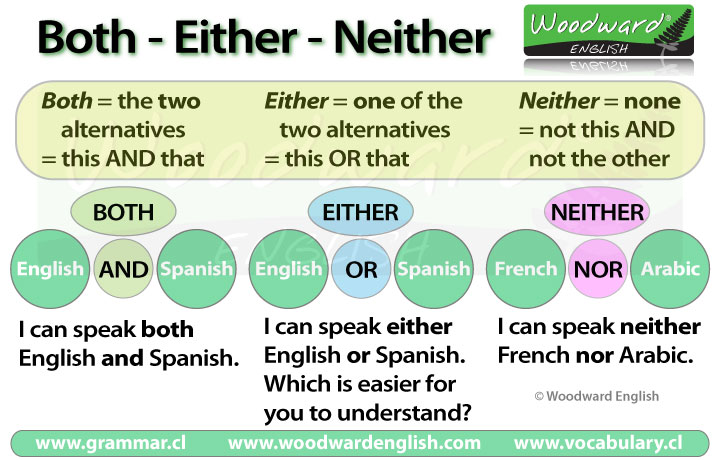
The difference between Both, Either and Neither - English Grammar 

Next activity

Try our interactive game to practice the difference between Both, Either and Neither.

Tuesday, 21 November 2017

LISTENING PRACTICE FOR KIDS

Maybe you are a teacher in search for materials for your class. Maybe you are a parent in search for listening practice for your kid. In m opinion, children should be exposed to the English language on a regular basis: daily if possible. 

Here you will find a list of websites where you will find lots of useful podcasts for children and beginners:

Rong-chang.com Easy short stories for children and ESL/EFL beginners. 

Hello-World.com Simple dialogues for non-native speaking children.

eslfast.com. A free site with lots of short stories and conversations.

Real English. Original videos and interactive lessons with some sample listenings.

Adele's corner. Easy online listening activities with blank filling exercises.

About.com English listening comprehension exercises for basic listening skills.

EnglishLingQ.com  Graded podcasts. 

Randall's ESL Cyber Listening Lab. See the section "Basic Listening Quizzes" with short listening activities for beginning and intermediate students.

Select-Language.com is an interesting site with graded audio-postcards from different English speaking communities.

Finally, these sites are also quite interesting:


Friday, 3 November 2017

WRITING A LETTER OF COMPLAINT

Letter/email of complaint

STRUCTURE:

Dear Sir/ Madam,

(INTRODUCTION)
 On (date), I (bought, leased, rented, or had repaired) a (name of the product, with serial or model number, or service performed) at (location and other important details of the transaction).

 (MAIN BODY)
Unfortunately, your (product or service) has not performed well (or the service was inadequate) because (state the problem). I am disappointed because (explain the problem: for example, the product does not work properly; the service was not performed correctly; I was billed the wrong amount; something was not disclosed clearly or was misrepresented; etc.).
 (CONCLUSION)
To resolve the problem, I would appreciate your (state the specific action you want: money refunded, charge card credit, repair, exchange, etc.). Enclosed are copies of my (receipts, guarantees, warranties, canceled checks, contracts, model and serial numbers, or any other documents).

I look forward to your reply and a resolution to my problem and will wait until (set a time limit) before seeking help from a consumer protection agency. Please contact me by phone at (home and/or office numbers with area code).

Yours faithfully,

Your name.


HERE YOU WILL FIND LOTS OF EXAMPLES


Tuesday, 10 October 2017

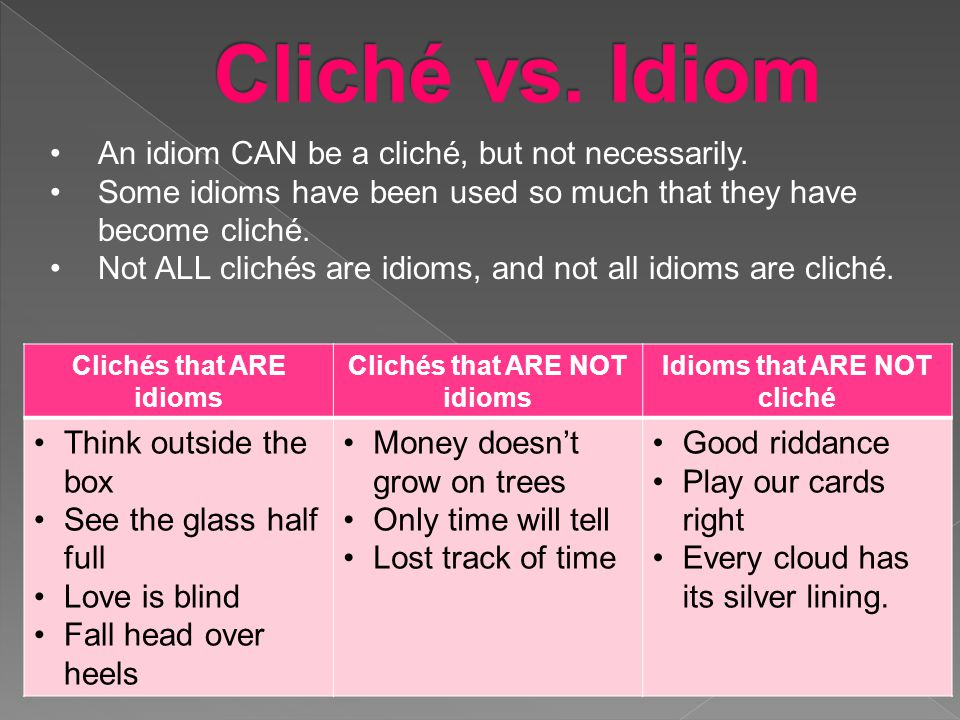
USE IDIOMS AND "CLICHÉS"!


An idiom is an expression that cannot be understood from the meanings of its separate words but that has a separate meaning of its own.
A cliché is a phrase or opinion that is overused and betrays a lack of original thought: “time heals all wounds” or “all is well that ends well” are quite recurrent in English.
Using clichés and idioms will help you expand your vocabulary and sound more native like.
You can find a list of clichés here, and a list of idioms here.

Image result for idiom and cliches

Tuesday, 6 June 2017

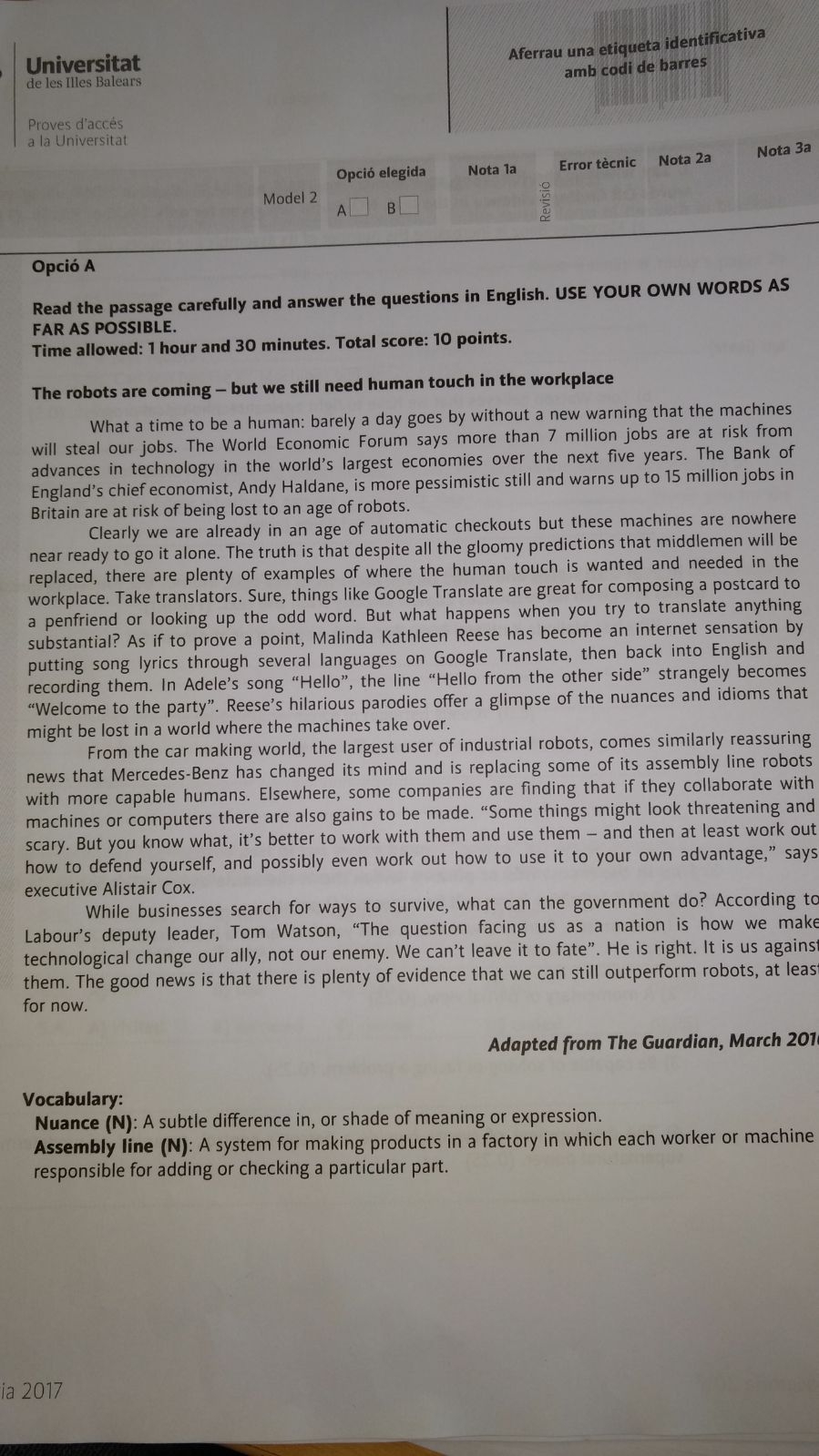
KEY TO THE ENGLISH PAU EXAM 2017 (ILLES BALEARS)


OPCIÓ A


1 a) This statement is FALSE, as the text says: " ...is replacing some of its assembly line robots with more capable humans".

   b) This statement is FALSE, as the text says: "...make technological change our ally, not our enemy".

2 (Possible answer): Malinda Kathleen Reese has become popular on the Internet because she has translated some song lyrics into different languages using Google Translate and then has translated them back into English, -using the same service-, before recording them with the resulting lyrics. Some of the songs are dramatically different after this process, and sound quite funny!

3 1- GLOOMY
   2- GLIMPSE
   3- TO WORK OUT
   4- FATE


4.1: A) HAVE you HAD A LOOK....?/ DID you HAVE A LOOK...? (AmE)
       B) .... robots ARE currently STEALING....

4.2: A) ...the HARDER....the EASIER...

4.3: People CAN'T (It is not allowed)/ MUST NOT or MUSTN'T (It is not allowed; it is prohibited)/ MAY NOT (It is formally / strictly not allowed) work....

4.4: Pamela told me not to believe (that) robots would do all the office work.


5.1 OTHER
5.2 WOMAN
5.3 ON
5.4 FOLLOWED


  • Organiza las ideas teniendo en cuenta que la redacción debe expresar tu opinión personal.
  • Comienza presentando el tema del que vas a escribir y tu opinión sobre él. 
  • Divide las ideas en párrafos (responde a las preguntas).
  • Utiliza expresiones para organizar, relacionar o añadir ideas: In addition, First, Therefore, Furthermore, I strongly believe, I think...
  • Conclusión: incluye una predicción acerca del futuro, por ejemplo.

En este ENLACE tenéis un ejemplo de OPINION ESSAY.


OPCIÓ B


1a) This statement is TRUE, as the text says: "To a certain extent, the answer to these questions may depend on your gender."
  b) This statement is TRUE, as the text says: "...people who have a rigid view of themselves and believe that personality cannot be changed are more likely to take rejection more personally,..."

2 (Possible answer): According to the text, people who suffer from anxiety or depression frequently experience problems in their relationships. Therefore, people who are emotionally unstable have a greater chance of breaking up than those who are positive and can work problems out by reaching an agreement.

3.1 SPLITS
3.2 TO GO THROUGH
3.3 LIKELY
3.4 DISTRESSING


4.1 A) What SHOULD I DO?
      B) If I were you, I WOULD TAKE a brief holiday....

4.2 A) There is no point in TRYING to convince him.
      B) ...in case Mark PHONES home.

4.3 A) ....he hasn't GOT (or GOTTEN in US and Canadian English) OVER his divorce yet.
      B) He really LET her DOWN.

4.4 The divorce papers are being signed.

5.1 LAUNDRY
5.2 NO
5.3 YOUNG
5.4 ASKED


  • Organiza las ideas teniendo en cuenta que la redacción debe expresar tu opinión personal.
  • Comienza presentando el tema del que vas a escribir y tu opinión sobre él. 
  • Divide las ideas en párrafos (responde a las preguntas).
  • Utiliza expresiones para organizar, relacionar o añadir ideas: In addition, First, Therefore, Furthermore, I strongly believe, I think...
  • Conclusión: incluye una predicción acerca del futuro, por ejemplo.

En este ENLACE tenéis un ejemplo de OPINION ESSAY.


Thursday, 10 November 2016

Lexical and grammatical collocations

A distinction may, if wished, be made between lexical collocations and grammatical collocations.


A lexical collocation is a type of construction where a verb, noun, adjective or adverb forms a predictable connection with another word, as in:
  • adverb + adjective: completely satisfied (NOT downright satisfied)
  • adjective + noun: excruciating pain (NOT excruciating joy)
  • noun + verb: lions roar (NOT lions shout)
  • verb + noun: commit suicide (NOT undertake suicide)
A grammatical collocation is a type of construction where for example a verb or adjective must be followed by a particular preposition, or a noun must be followed by a particular form of the verb, as in:
  • verb + preposition: depend on (NOT depend of)
  • adjective + preposition: afraid of (NOT afraid at)
  • noun + particular form of verb: strength to lift it (not strength lifting it)

Miscellaneous collocations:
TimeBusiness EnglishClassifiers
bang on time
dead on time
early 12th century
free time
from dawn till dusk
great deal of time
late 20th century
make time for
next few days
past few weeks
right on time
run out of time
save time
spare time
spend some time
take your time
tell someone the time
time goes by
time passes
waste time
annual turnover
bear in mind
break off negotiations
cease trading
chair a meeting
close a deal
close a meeting
come to the point
dismiss an offer
draw a conclusion
draw your attention to
launch a new product
lay off staff
go bankrupt
go into partnership
make a loss
make a profit
market forces
sales figures
take on staff
a ball of string

a bar of chocolate

a bottle of water

a bunch of carrots

a cube of sugar

a pack of cards

a pad of paper

Wednesday, 2 November 2016

AS vs LIKE


As

1: 'As' can mean 'because/since'.
  • As it was raining, we didn't go out.
2: 'As' can mean 'while' or 'at the same time':
  • As I was walking down the street, I saw Jimmy.
3: We can use 'as' to talk about the way one thing is similar to another thing. In this case 'as' is a conjunction and needs to be followed by a subject and a verb or by a prepositional phrase. We invert the subject and the verb when using a formal register.
  • James loves pets, as do I.
4: We need to use 'as' with expressions like 'as much as' and by 'as +adjective +as'. This is also talking about similarity. These expressions can be followed by a subject and a verb or a noun or preposition.
  • John loves spicy food as much as I do.
  • Lily travels as much as me.
  • She's as clever as her sister is.
  • London's not as big as Mexico City.
5: 'As' can be used with a noun to show someone's position. This is especially common with jobs. In a similar way, 'as' can also be used to show something's function (what we are using it for). It must be followed by a noun.
  • She works as a teacher.
  • Don't use the knife as a screwdriver.
Watch out! You can't use 'like' for someone's real job. You need to use 'as'.
  • I work like a waitress.
Like

1: 'Like' can be used to give examples. It means the same as 'for example' and is usually followed by nouns or pronouns.
  • Western European countries like France and Spain have high unemployment at the moment.
2: We can also use 'like' to talk about how one thing is similar to another thing. Here 'like' is a preposition and is followed by a noun or a pronoun.
  • John loves spicy food, like me.
  • Tokyo is a busy and exciting city, like London.
When we're talking about how things are similar, we often use 'like' with verbs such as 'look', 'sound' and 'smell'.
  • She looks like her mother.
  • It looks like rain.
  • That sounds like a car.
  • The kitchen smells like lemons.

'Like' vs 'as' for similarity

Often, we can use both 'as' and 'like' to talk about similarity.
  • I love coffee, like Julie.
  • I love coffee, as Julie does.
We need to follow 'as' with a clause (a subject and a verb). When we use 'as' for similarity, it's not followed by a noun or pronoun.
  • I love coffee, as Julie.
However, when we use 'as' to mean a role or job (it's followed by a noun in this case), then we can't use 'like'. Instead, 'like' is talking about similarity.
  • As your mother, I'm telling you not to go out now. (I am your mother and I am telling you this in my role as your mother.)
  • Like your mother, I'm telling you not to go out now. (I'm not your mother, but I am telling you the same thing as she is. I am acting in a similar way to your mother.)
Here's another example.
  • She works as the manager (= she is the manager).
  • She works like the manager (= she isn't the manager, but she works in a similar way to the manager).

Saturday, 10 September 2016

EL INGLÉS Y LAS REVÁLIDAS LOMCE: MODELOS

Como docentes, debemos preparar a nuestros alumnos lo mejor posible para que superen con éxito las reválidas LOMCE. En los meses de Mayo/Junio 2017 nuestros alumnos de 4º ESO y de 2º Bachillerato harán estas pruebas como "experiencia piloto", aunque no será hasta el 2018 que estas pruebas determinen la obtención o no del título de graduado en educación secundaria o de graduado en bachillerato.


Información general:

Las pruebas serán diseñadas por cada Comunidad Autónoma y se aplicará la misma prueba a todos los alumnos de esa Comunidad Autónoma. Los resultados de esta prueba contarán un 30% para su nota final mientras el otro 70% corresponderá a las notas obtenidas en su centro escolar. En el caso de bachillerato, los porcentajes serán 40% y 60%, respectivamente. 

Los alumnos podrán repetir la prueba si suspenden y también si quieren subir nota. Para ello, se contemplan cada curso una convocatoria ordinaria y otra extraordinaria.

Los resultados serán puestos en conocimiento de la comunidad educativa del propio centro, sin que puedan utilizarse en ningún caso para la elaboración de clasificaciones de centros docentes.


Las pruebas de lengua extranjera (inglés):

Parece que el examen de bachillerato no distará mucho del actual modelo de Selectividad. AQUÍ tenéis un modelo de un examen PAU 2016 en las Illes Balears. 

Según la normativa publicada por el MECD, el examen de secundaria (ESO) se centrará en las materias troncales y evaluará las siguientes competencias: comunicación lingüística, competencia matemática y competencias básicas en ciencia y tecnología, competencia digital, aprender a aprender, competencias sociales y cívicas, sentido de iniciativa y espíritu emprendedor, y conciencia y expresiones culturales.

Aunque cada Comunidad Autónoma desarrollará sus pruebas, es más que probable que las pruebas de inglés ESO se asemejen a las actuales pruebas libres para la obtención del graduado. 

Aquí os dejo varios modelos para que vuestros alumnos se familiaricen con el formato:


                                                        ¿Te ha sido útil?  Escríbeme un tweet! click to tweet


Thursday, 8 September 2016

A SELECTION OF PLACEMENT TESTS

An initial test on the first week of class can give you some information about how much English your students know.

The results of this test should not be taken into account to mark the student's year progress. It's just a way to know about the students' level at the beginning of the school year. 

It can also help them realize what things they should study better. 


Here are some tests you can use:


An elementary speaking test HERE


An oral placement test from A1 to C1 HERE


1st ESO


http://www.sul-schools.com/sites/default/files/files/Junior%20Placement%20Test.pdf


2nd ESO


http://promo.oupe.es/documents/diagnostic_test_secondary_1_incluir.pdf


3rd ESO


http://promo.oupe.es/documents/diagnostic_test_secondary_2_incluir.pdf


4th ESO


http://promo.oupe.es/documents/diagnostic_test_secondary_3_incluir.pdf


1st bachillerato/ Vocational studies


http://promo.oupe.es/documents/diagnostic_test_secondary_4_incluir.pdf


2nd bachillerato/University students


http://www.ubd.ua/upload/other-resourses/solutions/solutions-placement-test.pdf


A good placement test for adult learners HERE


A quick and a full placement test with answers HERE


A grammar and vocabulary placement test with key HERE


Some ONLINE level tests:


http://www.esl-lounge.com/student/level-test.php


http://www.cambridgeenglish.org/test-your-english/


https://www.esl-languages.com/en/study-abroad/online-tests/english-test/index.htm

                                        Did this help? Send me a tweet! click to tweet


Monday, 29 August 2016

IMPROVE YOUR WRITING: SPELLING RULES YOU SHOULD KNOW

Although English is a language with more exceptions than rules, we can improve our spelling by learning some basic rules and hope that the word we don't know follows the pattern.

1. The sound /ɪ/ ="ie", except after c
believe - receive

2. Plurals: changing "Y" into "IES"
When the word ends in a vowel + y just add ‘s’:

key → keys
delay → delays
trolley → trolleys
(because we can't have three vowels in a row)

If the word has a consonant before the ‘Y’, remove the ‘Y’ and add ‘IES’:

baby → babies
company → companies
difficulty → difficulties


3. Adding -ES to words ending in -s, -ss, -z -ch -sh -x:
This was added to stop the plural 's' clashing with these letters and it softens the 's' sound to a 'z' sound

bus→ buses
business → businesses
watch → watches
box → boxes
quiz → quizzes


4. The "consonant:vowel:consonant" doubling up rule:

put - putting, big-bigger, quiz - quizzes, swim - swimming...

When a word has one syllable and it ends in "consonant:vowel:consonant", we double up the final consonant with a vowel suffix:

sit - sitter, big - biggest, tap - tapping, shop - shopper/shopping, fat - fatten, fattening, fatter, fattest...

This happens in longer words when the stress is on the final syllable:

begin (beGIN) - beginner, beginning
refer (reFER) - referring, referred
occur (ocCUR) - occurring, occurred, occurrence


5. Drop the ‘e’ rule
We usually drop the final silent "e" when we add vowel suffix endings, for example:

write + ing → writing
hope + ed = hoped
excite + able = excitable
joke - joker
large - largish
close - closing
sense + ible = sensible
opposite + ion = opposition
imagine + ation = imagination

We keep the 'e' if the word ends in –CE or –GE to keep a soft sound, with able/ous

courage + ous = courageous
outrage + ous = outrageous
notice + able = noticeable
manage + able = manageable


6. Changing the "y" to "i" when adding suffix endings:
If a word ends in a consonant + Y, the Y changes to I (unless adding endings with "i": -ing/-ish, which already begins with an i)
beauty+ful > beauti+ful =beautiful, beautify, beautician
happy + ness = - happiness, happily, happier, happiest
angry + er = angrier, angriest, angrily,
pretty: prettier, prettiest BUT prettyish
ready: readily, readiness
dry: dried, BUT drying, dryish
defy: defies, defied, but defying
apply: applies, applied but applying


7. "-f" to "-ves" or "-s": Most words ending in "-f" or "-fe" change their plurals to "-ves"

calf - calves
half - halves
knife - knives
leaf - leaves
loaf - loaves
life - lives
wife - wives
shelf - shelves
thief - thieves
yourself - yourselves


BUT nouns which end in two vowels plus -f usually form plurals in the normal way, with just an -s:

chief - chiefs
spoof - spoofs
roof - roofs
chief - chiefs
oaf - oafs
EXCEPTIONS: thief - thieves, leaf - leaves

Some words can have both endings -ves or -s:

scarf - scarfs/scarves
dwarf - dwarfs/dwarves
wharf - wharfs/wharves
handkerchief - handkerchiefs/handkerchieves

Words ending in -ff you just add -s to make the plural:

cliff - cliffs
toff - toffs
scuff - scuffs
sniff - sniffs


8. Words ending in -ful
The suffix –FUL is always spelled with one L, for example:

grate + ful = grateful
faith + ful = faithful
hope + ful = hopeful
careful
helpful
useful
grateful


9. Adding -ly
When we add -ly to words ending in -ful then we have double "l":

gratefully
faithfully
hopefully

We also add -ly to words ending in 'e':

love + ly = lovely
like + ly = likely
live + ly = lively
complete + ly = completely
definite + ly = definitely

BUT not in truly (true + ly) This is a common misspelled word.
We change the end 'e' to 'y' in these "-le" words:

gentle > gently
idle > idly
subtle > subtly

10. When we add "all" to the beginning of words we drop the "l":

all + so = also
all + most = almost
although
always
almighty
already
alright 
altogether (adverb=in total, on the whole, completely)


                                        Did this help? Send me a tweet! click to tweet