Showing posts with label ADVANCED LANGUAGE. Show all posts

Sunday, 12 June 2016

SEPARATING WORDS AT THE END OF A LINE


This is not easy, so I always recommend my students never to divide a word at the end of a line. But in case you are wondering what the rules are, here you are:


1. Divide the word between syllables. This means, of course, that one-syllable words are never divided.
Incorrect:  Incorrect:  Correct:
sp-
orts
su-
pport
sup-
port

2. The hyphen goes at the end of the first line.
Incorrect:  Correct:  
sup
-port
sup-
port

3. Prefixes and suffixes make natural divisions.
Incorrect:  Correct:
in-
ternational  
inter-
national
                                                                                     (The prefix is inter.)


4. There should be at least two letters plus the hyphen on the first line and three letters on the second.
Incorrect:  Incorrect:  Correct:
e-
lect
supposed-
ly
sup-
posedly

5. Do not divide proper nouns or proper adjectives.
Incorrect:  Correct:
Wash-
ington
Washington

6. Divide hyphenated word using the hyphen already in the word.
Incorrect:  Correct:
moth-
er-in-law   
mother-
in-law


7. Do not divide a word at the end of a line if the parts of the word will be on two separate pages. This is hard for the reader to follow.

Monday, 10 August 2015

USEFUL VOCABULARY TO TALK ABOUT CRIMES


break-in


breaking and entering


burglary


the crime of entering a building illegally in order to steal things

carjacking


a crime in which someone attacks the driver of a car and steals the car. Someone who does this is called a carjacker.

extortion


a crime in which someone gets money or information from someone else by using force or threats

heist (informal)


 an organized attempt by thieves to steal something

hijacking


an occasion when someone illegally takes control of a vehicle, especially a plane, using violence or threats

hold-up


a situation in which someone threatens people in a bank or shop with a gun in order to get money or goods

identity theft


stealing information about someone that makes it possible to use their bank account or credit card

joyriding (informal)


the crime of stealing a car and driving it for pleasure, usually in a dangerous way. If you do this you joyride, and a person who does it is a joyrider.

larceny


the crime of stealing personal property

mugging


an attack on someone in a public place in order to steal their money, jewellery, or other possessions

phishing


the practice of trying to trick someone into giving their secret bank information by sending them an email that looks as if it comes from their bank and that asks them to give their account number or password

piracy


the crime of stealing things from ships while they are sailing

plunder


the act of taking valuable things from a place using force

raid


a crime in which someone suddenly enters a place and uses force or threats to steal money or goods

ram-raiding


the crime of driving a vehicle through a shop window in order to steal goods

robbery


the crime of taking money or property illegally, often by using threats or violence

rustling


the crime of stealing farm animals such as sheep, cows, or horses

shakedown (informal, AmE)


a situation in which someone uses threats to force someone else to give them money

shoplifting


the crime of stealing things from a shop

skimming


the crime of using electronic information from someone’s credit card or payment card after they have used it to pay for something

snatch


an act of stealing something or of taking someone away by force

stick-up (informal, AmE)


an occasion when someone tries to steal money from a bank, shop etc by threatening people with a gun

theft: 

the crime of stealing. Someone who commits this crime is called a thief

thieving: 

the act or practice of stealing

trespass: 

the crime of entering a place without the owner’s permission

violation: 

the action of entering an area or place without permission
looting: stealing goods from (a place), typically during a war or riot

pilfering: 

stealing things of little value

pillage: the act of robbing (a place) using violence, especially in wartime

smash-and-grab: a robbery in which the thief smashes a shop window and seizes goods


Wednesday, 10 June 2015

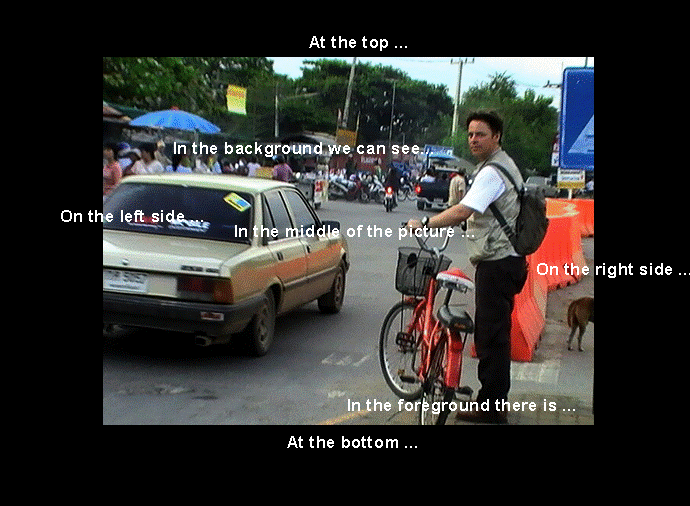
DESCRIBING AND COMPARING PICTURES


Describing the photographs The first photograph shows a woman reading a book

In the background we can see a family sitting around a table outside a café

Comparing the photographs Both pictures are about being a parent

I think the common theme here is communication


Contrasting In contrast, the people in the second image look worried

On the other hand, the scene looks much more modern

Unlike the first photo, this looks like a happy occasion


Speculating Perhaps they are celebrating something

Maybe the reason they look so serious is because ...

She might be a busy working mother

Personal feelings I wouldn't like to be in their shoes

The first photo reminds me of my own childhood

Personally, I'd love to visit a place like that


Hesitators (gaining time)
Well, ...

Hmmm... let me see

Rephrasing What I really mean is that ...

I take that back

What I am trying to say is that ...

Sunday, 1 February 2015

AT THE BUTCHER'S. THE WORDS YOU NEED!

This is a Spanish-English compilation of words one can find useful when going to the butcher's shop or at a restaurant.

Vaca                                 
Bife de chorizo - New York Cut
Bife de lomo - Filet Mignon
Colita - Culotte Steak
Chuleta - Pork Chop
Churrasco - Flank Steak
Entraña - Skirt Steak
Peceto - Eye of Round
Tira de asado - Short Ribs
Rabo - Oxtail
Mollejas - Sweetbreads
Solomillo o lomillo - Tenderloin
Redondo - Eye of Round
Pecho- Brisket
Aguja - Chuck
Corazón - heart
Chuleta - Rib steak
Riñon - Kidney
Panza - Tripe
Paleta - Chuck shoulder
Bife ancho, costillas - Ribs
Falda - Boneless Flank
Bife angosto - Striploin
Carne molida, picadillo - Ground Beef
Pierna entera - T bone
Rueda con cuadril - Round and Rump Steak
Rueda Sin garron o carne para asar - Round Steak
Bifes angostos con lomo y con cuadril - Full loin and rump
Cadera con tapilla - Full Rump
Bifes de vacio o Carne de falda magra - Flank Steak
Lomito - Sirloin


Aves
Pechuga - breast
Alas - wings
Muslo - drumstick
Cadera - thigh
Pescuezo - neck
Gallina - hen
Codorniz - Quail
Pavo - Turkey
Pato - Duck
Pichón - Pidgeon
Pollo - Chicken
Pollo entero - Fryer
Mollejas - Gizzards
Menudencias - Giblets
Higadillos - Chicken liver


Wednesday, 23 October 2013

TALKING ABOUT MONEY

The following idioms and expressions with the noun 'money' are common in every day conversation.

Each idiom or expression has a definition and two example sentences to help understanding of these common idiomatic expressions with 'money'.

Colour of someone's money
Definition: the amount of money someone has available
Show me the colour of your money and then we can talk.
If we knew the color of the company's money we could make a better bid on the deal. 

 
Easy money
Definition: money that can be earned with little effort
Some people think that playing stocks is easy money.
Unfortunately, there are few jobs are truly easy money.

Front money
Definition: money paid in advance of receiving something
I'll need to put up $100,000 front money to get in on the deal.
Always be suspicious of companies that ask for front money. 

 
Heavy money
Definition: a lot of money
Tom will bring heavy money into the company if he agrees to invest.
They have heavy money. I'm sure they'll buy the house. 

 
Hush money
Definition: money paid to someone so that they don't provide information
Many people are paid hush money to not testify in court. It's illegal, but it happens.
The gang tried to pay the man off with hush money, but he was having none of it. 

 
Mad money
Definition: money used to have fun, money to waste
We've put away a few thousand dollars in mad money for our next vacation.
Don't go to Las Vegas without some mad money. 

 
Money from home
Definition: easily gained money
Peter thinks investing in stocks is money from home.
She's looking for a job that's money from home. Good luck! 

 
Money grubber
Definition: someone who does not like to spend money, a stingy person
She'll never give you money for your idea. She's a money grubber.
Money grubbers can't take it with them. I have no idea why they take it so seriously. I say easy come, easy go. 

 
Money talks
Definition: money has influence in a situation
Of course they let the big box store build in town. Never forget: Money talks.
Just remember money talks. If they really want you for the position, they'll meet your salary demands. 

 
On the money
Definition: correct, exact
I'd say you are on the money about that situation.
His guess that the company would succeed was on the money. 

 
Put your money where your mouth is!
Definition: let's have a bet about something
Come on, if you think that is true, put your money where your mouth is! I'll bet you 100 to 1 that it isn't true.
She put her money where her mouth was and made a fortune. 

 
Smart money
Definition: the best option, money of smart people investing in something
The smart money is on congress changing the law.
He thinks the smart money is going to invest in renewable energy. 

 
Soft money
Definition: money which can be earned without much effort
Take the job for a few months. It's soft money.
Jane thinks the position is soft money. 

 
Spending money
Definition: money to spend to have fun, purchases unnecessary items
It's important to have at least a little spending money each month.
They don't have much spending money, so they like to stay home rather than go on vacation. 

 
Throw money at something
Definition: waste money on a situation
Throwing money at the situation isn't going to make it better.
Some governments feel that throwing money at a program always helps. 


Sunday, 9 June 2013

Steven Wright: funny quotes

A fun way to learn new words!


-If you think nobody cares about you, try missing a couple of payments.
-Drugs may lead to nowhere, but at least it's the scenic route.
-I'd kill for a Nobel Peace Prize.
-Bills travel through the mail at twice the speed of checks.
-Borrow money from pessimists-they don't expect it back.
-Half the people you know are below average.

Many more here!:
http://www.weather.net/zarg/ZarPages/stevenWright.html