Saturday, 14 May 2016

INGLÉS EN VERANO PARA NIÑOS Y TEENS: CAMPAMENTOS, INTERCAMBIOS...


Todos somos conscientes de que el idioma inglés es absolutamente necesario hoy en día, y que lo seguirá siendo en un futuro. Algunas familias me han pedido que os hable de las diferentes posibilidades para dar a vuestros hijos la oportunidad de vivir el idioma en un contexto real.


CAMPAMENTOS Y ESTANCIAS EN EXTRANJERO: 

Yo recomiendo la opción campamentos a los menores de 16 años. Vamos a ver las diferentes opciones:


OPCIÓN A) Preferís que la actividad sea en España, porque lo veis es muy joven para estar lejos de casa:

Hay muchas opciones en España que trabajan el concepto de "Campamentos de inmersión lingüística en inglés" desde diferentes ópticas. Algunos ofrecen clases diarias por la mañana y actividades complementarias, y otros se centran en actividades en inglés, sin lecciones. Si el niño es muy activo, la mejor opción es la segunda. 

Hay campamentos que se ofertan para diferentes franjas de edades: 6-16, 12-15, 10-15, etc. Siempre es mejor que el campamento esté articulado en torno a una franja de edad cercana a la del menor. En principio, una niña de 13 años estará mucho más a gusto en un campamento para niños de 12-15 años que en uno para niños de de 6-16.

Los precios varían en función de las actividades ofertadas. En general sale a unos 500€ por semana. Os dejo un enlace genial en el que encontraréis casi todas las opciones que podéis encontrar en España para este verano: 


OPCIÓN B) El menor está preparado para una estancia en el extranjero y para una inmersión lingüística y cultural total.

Normalmente esta opción incluye varias lecciones de inglés al día, excursiones, y estancia en residencia de estudiantes o con una familia.

En este caso, os recomiendo que enviéis al menor a un país angloparlante de la Unión Europea. Hay muchas ofertas para Inglaterra, pero yo siempre recomiendo Irlanda, por muchos motivos: la gente suele ser muy sociable y extrovertida, los índices de criminalidad son bajísimos, y su moneda es el euro.

Una estancia en Irlanda de dos semanas puede costar alrededor de 1400€ (sin el avión). Si lo contratáis con alguna agencia especializada en España, os costará unos 2600€ por dos semanas. En este caso el avión está incluido y el menor está siempre acompañado, pero el problema es que son grupos grandes de un mismo país y al final acaban hablando todos más español que inglés.


OPCIÓN C) El menor está preparado para una estancia en el extranjero y para una inmersión lingüística y cultural total, pero el presupuesto familiar no llega a las opciones anteriores.

Hay una plataforma en Internet llamada LINGOO. En ella, las familias se anuncian directamente para:

-Acoger a tu hijo en su casa como a uno más durante un mínimo de 1 semana. Suelen pedir unos 400€/semana.

-Buscar casa para enviar a su hijo al extranjero (si tenéis una habitación libre, también es una buena opción para vuestros hijos tener a un "hermano" extranjero 1-2 semanas en casa. En este caso, vosotros pondríais el precio por semana.

-Intercambio: Esta es la opción más económica, claro. Buscad a alguien de la misma edad, sexo y aficiones que vuestro hijo/a, y acordad las fechas del intercambio (1-2 semanas los dos aquí, y 1-2 semanas los dos allí, por ejemplo).


Esta última opción está fenomenal para vivir el idioma en un entorno familiar y real. No hay lecciones ni actividades multiaventura, es simplemente el día a día en otro país. Para registrarse hace falta un pago de 70€, así que se trata de familias serias. Si os decantáis por esta opción, os recomiendo que se establezca un contacto previo entre las familias via Skype, por ejemplo, para conoceros mejor.


Mucha suerte!!


Tuesday, 19 April 2016

MODELOS PRUEBAS EOI, DIFERENTES CCAA E IDIOMAS.

ÚLTIMA ACTUALIZACIÓN: 19/4/16


CANARIAS

CATALUÑA

COMUNIDAD VALENCIANA

GALICIA


MURCIA


Thursday, 7 April 2016

MODAL PERFECT VERBS


PHONETICS: / ʃ, ʒ ,tʃ and dʒ /

The /tʃ/ sound in English is most often represented by the initial/final letters 'ch', while/dʒ/ commonly appears as initial/final 'j', 'g', or 'dg'. 


The sounds /ʃ/ and /ʒ/ 

The /ʃ/ sound in English is most often represented by the letters 'sh'. The /ʒ/sound occurs less frequently in speech. It is is most often represented by the letter 's' and pronounced almost the same as /ʃ/ except it is voiced (between vowels). 


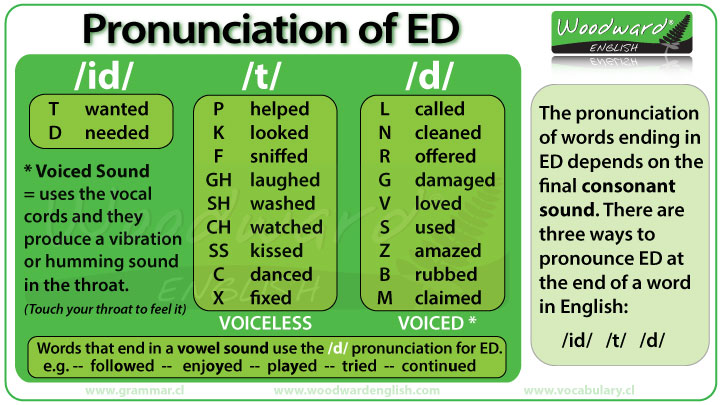
PHONETICS: WORDS ENDING IN -ED


Pronunciation of ED in English


An easy way to remember how to pronounce ED words

The most important thing to remember is that there are two main divisions:
  1. The words that end in T or D
    - the ED is pronounced as a syllable /id/
  2. and the REST of the words
    - you can pronounce the ED as /t/ and people will understand.
In time you will learn when to pronounce the ED as /t/ or /d/.

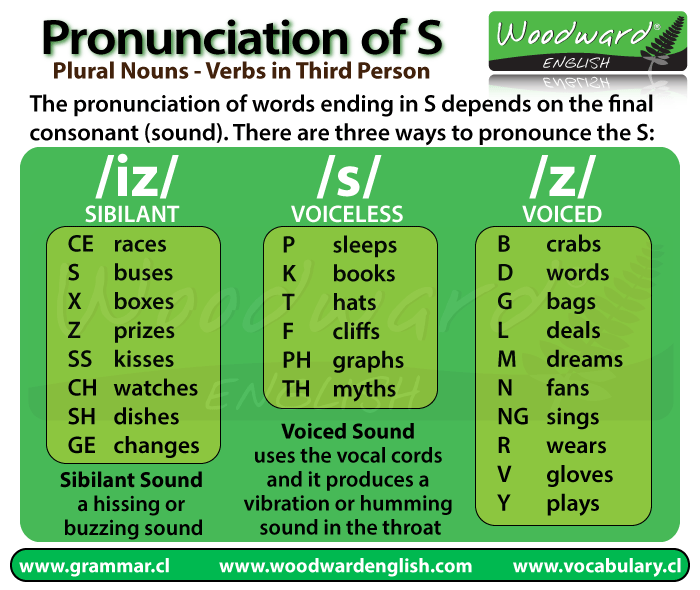
PHONETICS: Words and Plurals ending in -s: /s, z, ɪz /


Pronunciation of the final S in English

If the word is a plural word ending in "-s," there are definite patterns that you can follow:

If the singular ends in a unvoiced sound (no vibration in the larynx), the plural "-s"is pronounced /s/: 

[p], [t], [k], [f]


                                Unvoiced sounds (plural /s/)        

                                              /p/ (caps /kaps/)                
                                              /t/ (pats /pats/)                  
                                              /k/ (backs /baks/)               
                                              /f/  (safes /seɪfs/)               


If the singular ends in a voiced sound (vibration in the larynx), the plural "-s" is pronounced /z/. Also, if the singular ends in a vowel sound or a diphthong, the plural "-s" or "-es" is pronounced /z/.


Vowels, diphthongs, [b], [d], [g], [l], [r], [w], [m], [n], [v], [y]


 Voiced sounds (plural /z/)   

ways /weɪz/
frees /friːz/ 
tries /trʌɪz/ 
shows /ʃəʊ/
cues /kjuːz/ 
boys /bɔɪz/
jaws /dʒɔːz/                                                                        

                          /b/ (cabs /kabz/)     /m/ (cams /kamz/)
                         /d/ (pads /padz/)    /n/ (pans /panz/)
                        /ɡ/ (bags /baɡz/)      /ŋ/ (bangs /baŋz/)
                       /v/ (saves /seɪvz/)
                                                          /l/ (falls /fɔːlz/)
                                                          (/r/ (cars /kärz/ in US Eng/Scottish.)


If the singular ends in a sibilant sound (/s/, /z/, /ʃ/, /ʒ/, /tʃ/, /dʒ/), the plural (written as "-es") and is pronounced /ɪz/.

________________________________________________        
Sibilant sounds (plural /ɪz/):
             /s/ (buses /bʌsɪz/                /z/ (buzzes /bʌzɪz/)
             /ʃ/ (rushes /rʌʃɪz/               /ʒ/ (rouges /ruːʒɪz/)
             /tʃ/ (batches /batʃɪz/)        /dʒ/ (badges /badʒɪz/)

A special case of a sibilant letter is the letter "x" /ks/ (boxes /bɒksɪz/)
________________________________________________


Now practise! 1

Tuesday, 15 March 2016

GRAMMAR ACTIVITIES ON ST PATRICK'S DAY

St.PatrickDay.jpg

Let's watch a Power Point HERE

Complete the passage with suitable relative pronouns. There may be more than one correct answer. 


March 17th is an Irish holiday 1. ............................... honours the patron saint of Ireland, St Patrick, 2................................ brought Christianity to the Irish people. According to tradition, St Patrick, 3................................ father was a wealthy man, was actually born in England. At the age of 16, he was kidnapped by pirates and sold as a slave. Some years later, he escaped to France, 4................................ he lived for many years and became a priest. At the age of 60, 5................................ he returned to Ireland, he built his first church. On March 17th, the day 6................................ St Patrick died, people wear green clothes decorated with the shamrock, 7................................ is the national symbol of Ireland.


Read and complete with a suitable word:

St Patrick’s Day: How England came to celebrate Irish culture
The Irish around the world gather to celebrate their culture on St Patrick’s Day, but in recent times increasing numbers of English people have been keen to join the party.
A survey ______________ was conducted for British Future last year found ___________English people were more likely to be able to remember the date of St Patrick’s Day than St George’s Day and suggested many were “too nervous” to celebrate their own patron saint on 23 April.
The first celebrations for St Patrick were recorded in Boston, Massachusetts, in 1737. It is believed ________ Saint Patrick, ______________ is the patron saint of Ireland, was born in either Scotland or Wales in the fourth century. He was taken to Ireland as a slave, __________ he was 16 years old, but escaped after six years. It was during his capture _______________ he turned to God.
Saint Patrick is traditionally associated with the Shamrock plant, _____________ he used to explain the concept of the Trinity. He is credited with playing a major role in converting the Irish to Christianity after returning to the country as a missionary. Legend also says that St. Patrick could raise people from the dead and he is well-known from driving all the snakes out of Ireland, although many people dispute the truth in this.
On St. Paddy’s day, pictures of shamrocks and leprechauns are hung everywhere. Some people even dress up as leprechauns complete with their big green hats. The Irish say that if a leprechaun is caught by a human, he will reveal where he hides his pot of gold.
Mike Cronin, _____________ wrote The Wearing of the Green: A History of St Patrick’s Day, said the earliest mention of the festival in England came in the 19th Century, ____________ it was seen as important for the Irish to attend mass on 17 March.
“In later decades of the 19th Century, particularly in London and Birmingham, you would see very small, local parades,” he said. “After the Second World War they became much more formal, usually based around different Irish societies such as the counties ______________ people came from, so you might have the Dublin society or a Mayo society parade.”
St Patrick’s Day faded in England, Mr Cronin said, during the darkest days of the Troubles ___________ there was a nervousness about celebrating Irishness. The only parade ______________ continued through all the years of the Troubles was the London one.
But, in the 1990s, there was a huge upsurge of the Irish-themed bar. English people became much more used to the idea ___________ they were going to this bar on this day because it was St Patrick’s Day and Guinness would be giving out free hats and whatever else. Suddenly it was acceptable to be performing Irishness out on the streets again.
Now, Irish pub owners go crazy putting green food colouring into their beers and traditional Irish Guinness sells out in all Irish pubs. People also drink lots of Irish coffee, ___________ is made with warm whiskey, sugar, coffee and topped off with whipped cream. As for food, corned beef and cabbage is a consistently popular dish. Another option is Irish soda bread and potato pancakes.
St. Patrick’s Day is celebrated world-wide with people dancing and singing in Irish pubs, watching the St. Patrick’s Day parade and wearing green clothes. The English are drawn to the celebrations due to their “jubilant party nature”, in the same way people around the globe are.

Questions on the text:
  • Why are English people too ‘nervous’ to celebrate their own Saint’s day?
  • When are where was St. Patrick born?
  • Why is he a patron saint?
  • How did St. Patrick use the Shamrock?
  • What are leprechauns?
  • What were ‘the Troubles’?
  • Why did St. Patrick’s Day become popular again?
  • What do people eat and drink on St. Patrick’s Day?

MOLLY MALONE SING IT ALONG! 

Lyrics and translation HERE