
Wednesday, 25 October 2017

Tuesday, 10 October 2017
USE IDIOMS AND "CLICHÉS"!
An idiom is an expression that cannot be understood from the meanings of its separate words but that has a separate meaning of its own.
A cliché is a phrase or opinion that is overused and betrays a lack of original thought: “time heals all wounds” or “all is well that ends well” are quite recurrent in English.
Using clichés and idioms will help you expand your vocabulary and sound more native like.
You can find a list of clichés here, and a list of idioms here.

Tuesday, 6 June 2017
KEY TO THE ENGLISH PAU EXAM 2017 (ILLES BALEARS)
OPCIÓ A
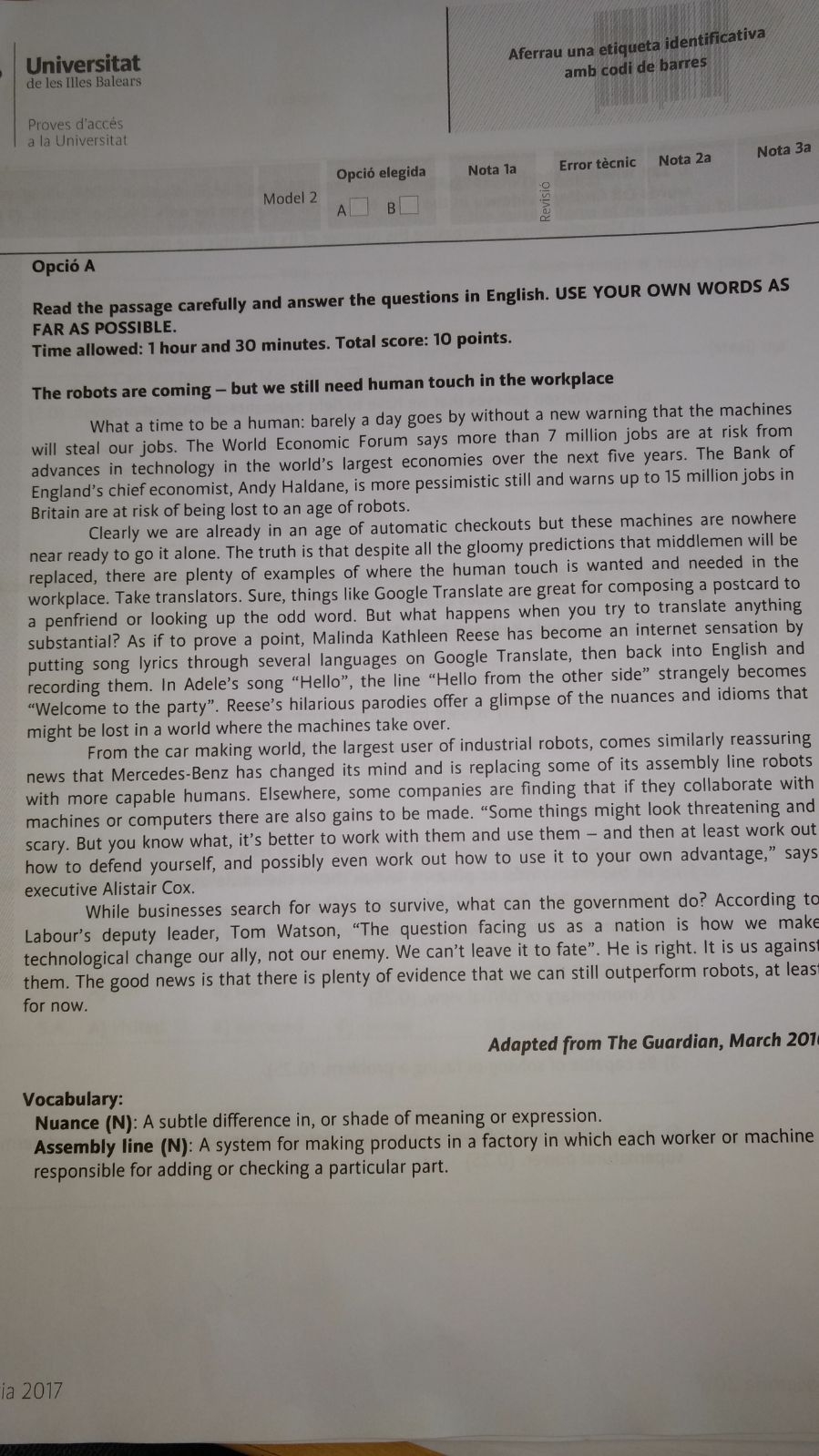

1 a) This statement is FALSE, as the text says: " ...is replacing some of its assembly line robots with more capable humans".
b) This statement is FALSE, as the text says: "...make technological change our ally, not our enemy".
2 (Possible answer): Malinda Kathleen Reese has become popular on the Internet because she has translated some song lyrics into different languages using Google Translate and then has translated them back into English, -using the same service-, before recording them with the resulting lyrics. Some of the songs are dramatically different after this process, and sound quite funny!
3 1- GLOOMY
2- GLIMPSE
3- TO WORK OUT
4- FATE


4.1: A) HAVE you HAD A LOOK....?/ DID you HAVE A LOOK...? (AmE)
B) .... robots ARE currently STEALING....
4.2: A) ...the HARDER....the EASIER...
4.3: People CAN'T (It is not allowed)/ MUST NOT or MUSTN'T (It is not allowed; it is prohibited)/ MAY NOT (It is formally / strictly not allowed) work....
4.4: Pamela told me not to believe (that) robots would do all the office work.
5.1 OTHER
5.2 WOMAN
5.3 ON
5.4 FOLLOWED

- Organiza las ideas teniendo en cuenta que la redacción debe expresar tu opinión personal.
- Comienza presentando el tema del que vas a escribir y tu opinión sobre él.
- Divide las ideas en párrafos (responde a las preguntas).
- Utiliza expresiones para organizar, relacionar o añadir ideas: In addition, First, Therefore, Furthermore, I strongly believe, I think...
- Conclusión: incluye una predicción acerca del futuro, por ejemplo.
En este ENLACE tenéis un ejemplo de OPINION ESSAY.
OPCIÓ B


1a) This statement is TRUE, as the text says: "To a certain extent, the answer to these questions may depend on your gender."
b) This statement is TRUE, as the text says: "...people who have a rigid view of themselves and believe that personality cannot be changed are more likely to take rejection more personally,..."
2 (Possible answer): According to the text, people who suffer from anxiety or depression frequently experience problems in their relationships. Therefore, people who are emotionally unstable have a greater chance of breaking up than those who are positive and can work problems out by reaching an agreement.
3.1 SPLITS
3.2 TO GO THROUGH
3.3 LIKELY
3.4 DISTRESSING
4.1 A) What SHOULD I DO?
B) If I were you, I WOULD TAKE a brief holiday....
4.2 A) There is no point in TRYING to convince him.
B) ...in case Mark PHONES home.
4.3 A) ....he hasn't GOT (or GOTTEN in US and Canadian English) OVER his divorce yet.
B) He really LET her DOWN.
4.4 The divorce papers are being signed.
5.1 LAUNDRY
5.2 NO
5.3 YOUNG
5.4 ASKED


- Organiza las ideas teniendo en cuenta que la redacción debe expresar tu opinión personal.
- Comienza presentando el tema del que vas a escribir y tu opinión sobre él.
- Divide las ideas en párrafos (responde a las preguntas).
- Utiliza expresiones para organizar, relacionar o añadir ideas: In addition, First, Therefore, Furthermore, I strongly believe, I think...
- Conclusión: incluye una predicción acerca del futuro, por ejemplo.
En este ENLACE tenéis un ejemplo de OPINION ESSAY.
Thursday, 10 November 2016
Lexical and grammatical collocations
A distinction may, if wished, be made between lexical collocations and grammatical collocations.
A lexical collocation is a type of construction where a verb, noun, adjective or adverb forms a predictable connection with another word, as in:
- adverb + adjective: completely satisfied (NOT
downrightsatisfied) - adjective + noun: excruciating pain (NOT excruciating
joy) - noun + verb: lions roar (NOT lions
shout) - verb + noun: commit suicide (NOT
undertakesuicide)
A grammatical collocation is a type of construction where for example a verb or adjective must be followed by a particular preposition, or a noun must be followed by a particular form of the verb, as in:
- verb + preposition: depend on (NOT depend
of) - adjective + preposition: afraid of (NOT afraid
at) - noun + particular form of verb: strength to lift it (not strength
lifting it)
Miscellaneous collocations:
| Time | Business English | Classifiers |
|---|---|---|
| bang on time dead on time early 12th century free time from dawn till dusk great deal of time late 20th century make time for next few days past few weeks right on time run out of time save time spare time spend some time take your time tell someone the time time goes by time passes waste time | annual turnover bear in mind break off negotiations cease trading chair a meeting close a deal close a meeting come to the point dismiss an offer draw a conclusion draw your attention to launch a new product lay off staff go bankrupt go into partnership make a loss make a profit market forces sales figures take on staff | a ball of string a bar of chocolate a bottle of water a bunch of carrots a cube of sugar a pack of cards a pad of paper |
Wednesday, 2 November 2016
AS vs LIKE
As
1: 'As' can mean 'because/since'.
- As it was raining, we didn't go out.
- As I was walking down the street, I saw Jimmy.
- James loves pets, as do I.
- John loves spicy food as much as I do.
- Lily travels as much as me.
- She's as clever as her sister is.
- London's not as big as Mexico City.
- She works as a teacher.
- Don't use the knife as a screwdriver.
I work like a waitress.
1: 'Like' can be used to give examples. It means the same as 'for example' and is usually followed by nouns or pronouns.
- Western European countries like France and Spain have high unemployment at the moment.
- John loves spicy food, like me.
- Tokyo is a busy and exciting city, like London.
- She looks like her mother.
- It looks like rain.
- That sounds like a car.
- The kitchen smells like lemons.
'Like' vs 'as' for similarity
Often, we can use both 'as' and 'like' to talk about similarity.
- I love coffee, like Julie.
- I love coffee, as Julie does.
I love coffee, as Julie.
- As your mother, I'm telling you not to go out now. (I am your mother and I am telling you this in my role as your mother.)
- Like your mother, I'm telling you not to go out now. (I'm not your mother, but I am telling you the same thing as she is. I am acting in a similar way to your mother.)
- She works as the manager (= she is the manager).
- She works like the manager (= she isn't the manager, but she works in a similar way to the manager).
Saturday, 10 September 2016
EL INGLÉS Y LAS REVÁLIDAS LOMCE: MODELOS
Como docentes, debemos preparar a nuestros alumnos lo mejor posible para que superen con éxito las reválidas LOMCE. En los meses de Mayo/Junio 2017 nuestros alumnos de 4º ESO y de 2º Bachillerato harán estas pruebas como "experiencia piloto", aunque no será hasta el 2018 que estas pruebas determinen la obtención o no del título de graduado en educación secundaria o de graduado en bachillerato.
Información general:
Las pruebas serán diseñadas por cada Comunidad Autónoma y se aplicará la misma prueba a todos los alumnos de esa Comunidad Autónoma. Los resultados de esta prueba contarán un 30% para su nota final mientras el otro 70% corresponderá a las notas obtenidas en su centro escolar. En el caso de bachillerato, los porcentajes serán 40% y 60%, respectivamente.
Los alumnos podrán repetir la prueba si suspenden y también si quieren subir nota. Para ello, se contemplan cada curso una convocatoria ordinaria y otra extraordinaria.
Los resultados serán puestos en conocimiento de la comunidad educativa del propio centro, sin que puedan utilizarse en ningún caso para la elaboración de clasificaciones de centros docentes.
Las pruebas de lengua extranjera (inglés):
Las pruebas de lengua extranjera (inglés):
Parece que el examen de bachillerato no distará mucho del actual modelo de Selectividad. AQUÍ tenéis un modelo de un examen PAU 2016 en las Illes Balears.
Según la normativa publicada por el MECD, el examen de secundaria (ESO) se centrará en las materias troncales y evaluará las siguientes competencias: comunicación lingüística, competencia matemática y competencias básicas en ciencia y tecnología, competencia digital, aprender a aprender, competencias sociales y cívicas, sentido de iniciativa y espíritu emprendedor, y conciencia y expresiones culturales.
Aunque cada Comunidad Autónoma desarrollará sus pruebas, es más que probable que las pruebas de inglés ESO se asemejen a las actuales pruebas libres para la obtención del graduado.
Aquí os dejo varios modelos para que vuestros alumnos se familiaricen con el formato:
Thursday, 8 September 2016
A SELECTION OF PLACEMENT TESTS
An initial test on the first week of class can give you some information about how much English your students know.
The results of this test should not be taken into account to mark the student's year progress. It's just a way to know about the students' level at the beginning of the school year.
It can also help them realize what things they should study better.
Here are some tests you can use:
An elementary speaking test HERE
An oral placement test from A1 to C1 HERE
1st ESO
http://www.sul-schools.com/sites/default/files/files/Junior%20Placement%20Test.pdf
2nd ESO
http://promo.oupe.es/documents/diagnostic_test_secondary_1_incluir.pdf
3rd ESO
http://promo.oupe.es/documents/diagnostic_test_secondary_2_incluir.pdf
4th ESO
http://promo.oupe.es/documents/diagnostic_test_secondary_3_incluir.pdf
1st bachillerato/ Vocational studies
http://promo.oupe.es/documents/diagnostic_test_secondary_4_incluir.pdf
2nd bachillerato/University students
http://www.ubd.ua/upload/other-resourses/solutions/solutions-placement-test.pdf
A good placement test for adult learners HERE
A quick and a full placement test with answers HERE
A grammar and vocabulary placement test with key HERE
Some ONLINE level tests:
http://www.esl-lounge.com/student/level-test.php
http://www.cambridgeenglish.org/test-your-english/
https://www.esl-languages.com/en/study-abroad/online-tests/english-test/index.htm
Did this help? Send me a tweet!

Subscribe to:
Posts (Atom)