Letter/email of complaint
STRUCTURE:
Dear Sir/ Madam,
(INTRODUCTION)
On (date), I (bought, leased, rented, or had repaired) a (name of the product, with serial or model number, or service performed) at (location and other important details of the transaction).
(MAIN BODY)
Unfortunately, your (product or service) has not performed well (or the service was inadequate) because (state the problem). I am disappointed because (explain
the problem: for example, the product does not work properly; the
service was not performed correctly; I was billed the wrong amount;
something was not disclosed clearly or was misrepresented; etc.).
(CONCLUSION)
To resolve the problem, I would appreciate your (state the specific action you want: money refunded, charge card credit, repair, exchange, etc.). Enclosed are copies of my (receipts, guarantees, warranties, canceled checks, contracts, model and serial numbers, or any other documents).
I look forward to your reply and a resolution to my problem and will wait until (set a time limit) before
seeking help from a consumer protection agency. Please contact me by phone at (home and/or office numbers with area code).
Yours faithfully,
Your name.
HERE YOU WILL FIND LOTS OF EXAMPLES
Friday, 3 November 2017

Wednesday, 25 October 2017


Tuesday, 10 October 2017
USE IDIOMS AND "CLICHÉS"!
An idiom is an expression that cannot be understood from the meanings of its separate words but that has a separate meaning of its own.
A cliché is a phrase or opinion that is overused and betrays a lack of original thought: “time heals all wounds” or “all is well that ends well” are quite recurrent in English.
Using clichés and idioms will help you expand your vocabulary and sound more native like.
You can find a list of clichés here, and a list of idioms here.

Tuesday, 6 June 2017
KEY TO THE ENGLISH PAU EXAM 2017 (ILLES BALEARS)
OPCIÓ A
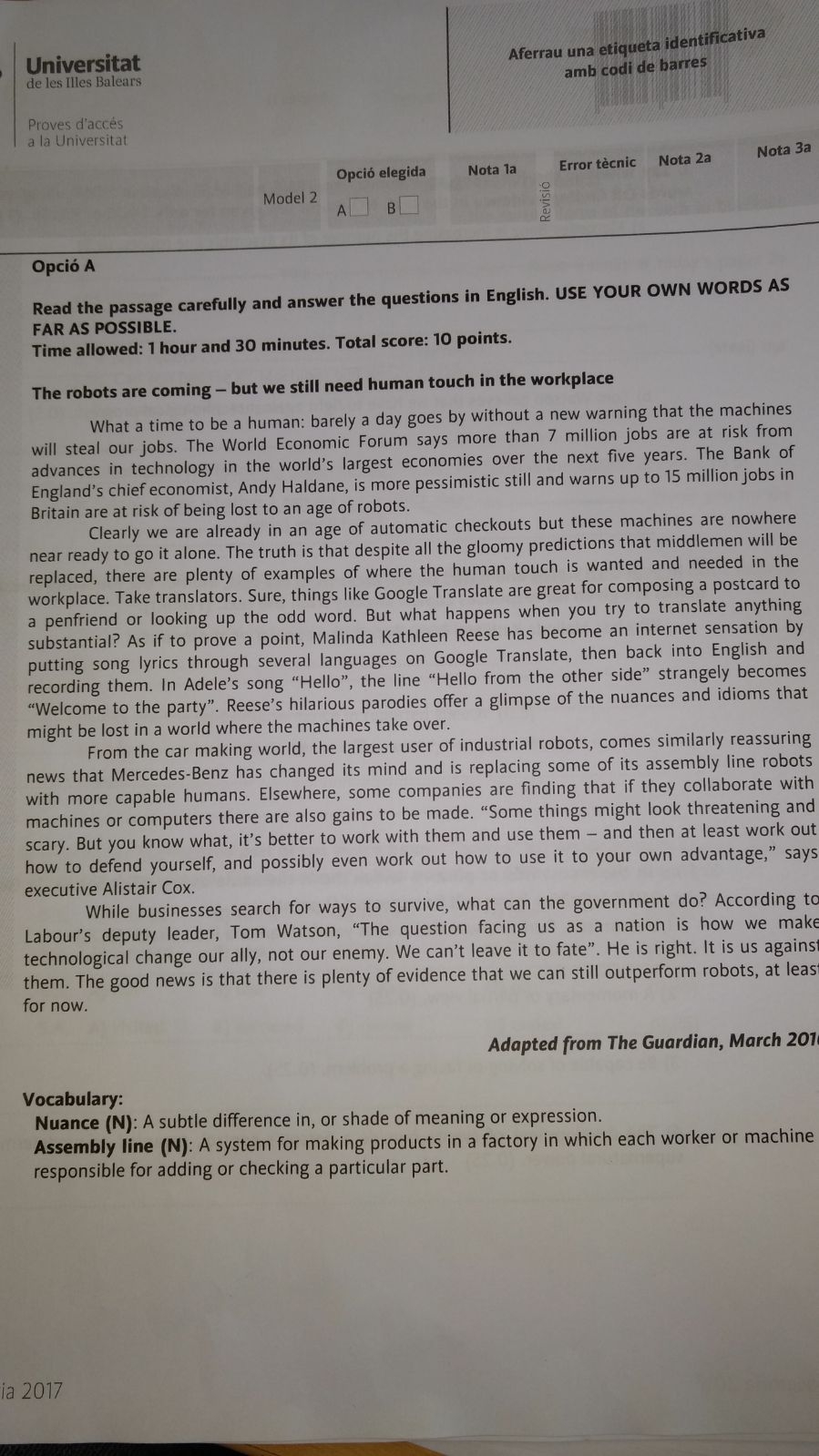

1 a) This statement is FALSE, as the text says: " ...is replacing some of its assembly line robots with more capable humans".
b) This statement is FALSE, as the text says: "...make technological change our ally, not our enemy".
2 (Possible answer): Malinda Kathleen Reese has become popular on the Internet because she has translated some song lyrics into different languages using Google Translate and then has translated them back into English, -using the same service-, before recording them with the resulting lyrics. Some of the songs are dramatically different after this process, and sound quite funny!
3 1- GLOOMY
2- GLIMPSE
3- TO WORK OUT
4- FATE


4.1: A) HAVE you HAD A LOOK....?/ DID you HAVE A LOOK...? (AmE)
B) .... robots ARE currently STEALING....
4.2: A) ...the HARDER....the EASIER...
4.3: People CAN'T (It is not allowed)/ MUST NOT or MUSTN'T (It is not allowed; it is prohibited)/ MAY NOT (It is formally / strictly not allowed) work....
4.4: Pamela told me not to believe (that) robots would do all the office work.
5.1 OTHER
5.2 WOMAN
5.3 ON
5.4 FOLLOWED

- Organiza las ideas teniendo en cuenta que la redacción debe expresar tu opinión personal.
- Comienza presentando el tema del que vas a escribir y tu opinión sobre él.
- Divide las ideas en párrafos (responde a las preguntas).
- Utiliza expresiones para organizar, relacionar o añadir ideas: In addition, First, Therefore, Furthermore, I strongly believe, I think...
- Conclusión: incluye una predicción acerca del futuro, por ejemplo.
En este ENLACE tenéis un ejemplo de OPINION ESSAY.
OPCIÓ B


1a) This statement is TRUE, as the text says: "To a certain extent, the answer to these questions may depend on your gender."
b) This statement is TRUE, as the text says: "...people who have a rigid view of themselves and believe that personality cannot be changed are more likely to take rejection more personally,..."
2 (Possible answer): According to the text, people who suffer from anxiety or depression frequently experience problems in their relationships. Therefore, people who are emotionally unstable have a greater chance of breaking up than those who are positive and can work problems out by reaching an agreement.
3.1 SPLITS
3.2 TO GO THROUGH
3.3 LIKELY
3.4 DISTRESSING
4.1 A) What SHOULD I DO?
B) If I were you, I WOULD TAKE a brief holiday....
4.2 A) There is no point in TRYING to convince him.
B) ...in case Mark PHONES home.
4.3 A) ....he hasn't GOT (or GOTTEN in US and Canadian English) OVER his divorce yet.
B) He really LET her DOWN.
4.4 The divorce papers are being signed.
5.1 LAUNDRY
5.2 NO
5.3 YOUNG
5.4 ASKED


- Organiza las ideas teniendo en cuenta que la redacción debe expresar tu opinión personal.
- Comienza presentando el tema del que vas a escribir y tu opinión sobre él.
- Divide las ideas en párrafos (responde a las preguntas).
- Utiliza expresiones para organizar, relacionar o añadir ideas: In addition, First, Therefore, Furthermore, I strongly believe, I think...
- Conclusión: incluye una predicción acerca del futuro, por ejemplo.
En este ENLACE tenéis un ejemplo de OPINION ESSAY.
Thursday, 10 November 2016
Lexical and grammatical collocations
A distinction may, if wished, be made between lexical collocations and grammatical collocations.
A lexical collocation is a type of construction where a verb, noun, adjective or adverb forms a predictable connection with another word, as in:
- adverb + adjective: completely satisfied (NOT
downrightsatisfied) - adjective + noun: excruciating pain (NOT excruciating
joy) - noun + verb: lions roar (NOT lions
shout) - verb + noun: commit suicide (NOT
undertakesuicide)
A grammatical collocation is a type of construction where for example a verb or adjective must be followed by a particular preposition, or a noun must be followed by a particular form of the verb, as in:
- verb + preposition: depend on (NOT depend
of) - adjective + preposition: afraid of (NOT afraid
at) - noun + particular form of verb: strength to lift it (not strength
lifting it)
Miscellaneous collocations:
| Time | Business English | Classifiers |
|---|---|---|
| bang on time dead on time early 12th century free time from dawn till dusk great deal of time late 20th century make time for next few days past few weeks right on time run out of time save time spare time spend some time take your time tell someone the time time goes by time passes waste time | annual turnover bear in mind break off negotiations cease trading chair a meeting close a deal close a meeting come to the point dismiss an offer draw a conclusion draw your attention to launch a new product lay off staff go bankrupt go into partnership make a loss make a profit market forces sales figures take on staff | a ball of string a bar of chocolate a bottle of water a bunch of carrots a cube of sugar a pack of cards a pad of paper |
Wednesday, 2 November 2016
AS vs LIKE
As
1: 'As' can mean 'because/since'.
- As it was raining, we didn't go out.
- As I was walking down the street, I saw Jimmy.
- James loves pets, as do I.
- John loves spicy food as much as I do.
- Lily travels as much as me.
- She's as clever as her sister is.
- London's not as big as Mexico City.
- She works as a teacher.
- Don't use the knife as a screwdriver.
I work like a waitress.
1: 'Like' can be used to give examples. It means the same as 'for example' and is usually followed by nouns or pronouns.
- Western European countries like France and Spain have high unemployment at the moment.
- John loves spicy food, like me.
- Tokyo is a busy and exciting city, like London.
- She looks like her mother.
- It looks like rain.
- That sounds like a car.
- The kitchen smells like lemons.
'Like' vs 'as' for similarity
Often, we can use both 'as' and 'like' to talk about similarity.
- I love coffee, like Julie.
- I love coffee, as Julie does.
I love coffee, as Julie.
- As your mother, I'm telling you not to go out now. (I am your mother and I am telling you this in my role as your mother.)
- Like your mother, I'm telling you not to go out now. (I'm not your mother, but I am telling you the same thing as she is. I am acting in a similar way to your mother.)
- She works as the manager (= she is the manager).
- She works like the manager (= she isn't the manager, but she works in a similar way to the manager).
Subscribe to:
Posts (Atom)